
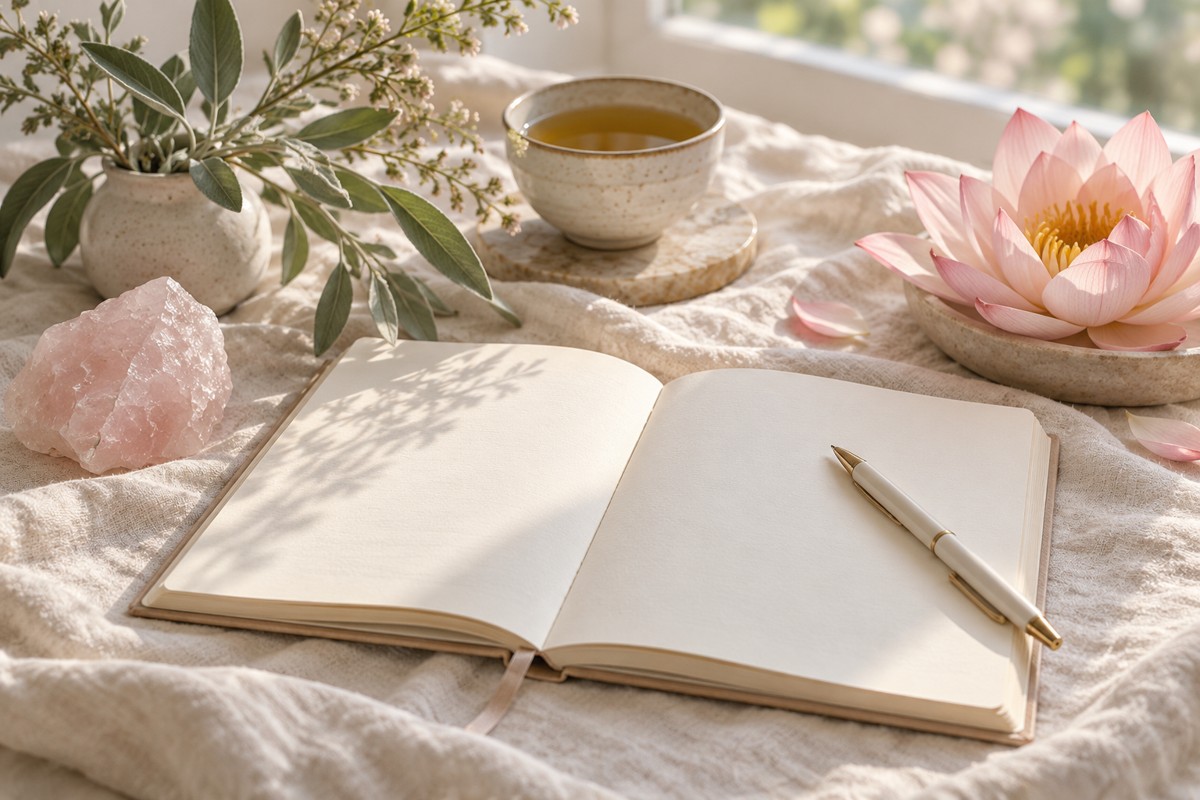
Before you open your journal, I want to offer you a little permission: you do not have to make this page beautiful.
It does not need to sound wise. It does not need to become a story you can share. A few honest words can be enough.
The slowing down I value in Reiki also shapes the invitation I want to offer here. Let the page be somewhere you can stop keeping up for a moment and notice yourself.
If you have a notebook with only a few pages filled, you can turn to the next page. There is no need to explain the gap.
Journaling is a personal way of putting thoughts, feelings, and observations into words. I want you to find a version that feels usable in your life, whether that is a sentence, a list, or a longer reflection.
What Can Journaling Look Like?
A journal can hold many different things.
A few sentences about your day.
A list of things you are grateful for.
A question you do not yet know how to answer.
A memory.
An intention.
Or an honest description of how you feel.
Some people enjoy writing freely. Others prefer prompts, short lists, sketches, or a few words at a time.
A notebook, a digital document, or a private note on your phone can all become places for reflection.
Choose the format that makes it easier to be honest with yourself. A beautiful notebook is optional; a place that feels private and usable matters more.
Why Do People Journal?
People may turn to journaling to make room for their thoughts, explore decisions, remember meaningful moments, or reconnect with their values.
Writing can give you something concrete to return to.
You might notice that certain situations repeatedly leave you feeling tired.
That a particular activity brings you joy.
That a boundary matters more than you realized.
Or that you have grown in ways you had not paused to acknowledge.
You do not need to uncover something important every time you write.
An entry that says “Today was a lot, and I need a quiet evening” has done something meaningful: it has given your experience a place on the page.
Start With What Is Here
If you are unsure what to write, begin with the present moment.
Try:
Right now, I notice…
You might describe the light coming through the window, the sound of rain, or the thoughts moving through your mind.
Then, if you would like, continue with:
Today, I feel…
Something taking up space in my mind is…
One thing I need is…
There is no requirement to explain everything.
A single honest sentence is a complete place to start.
Create a Practice You Can Return To
It can be tempting to decide that you will write every morning, fill several pages, and never miss a day.
But a practice can be meaningful without being demanding.
Begin with five minutes.
Or three sentences.
Or one entry a week.
You might write after your morning tea, before bed, or whenever you notice that you would like a moment of reflection.
Let your routine support you.
If you miss a day—or a month—you can return without catching up.
I want returning to your journal to feel like opening a door, not catching up on homework.
Five Gentle Prompts for Beginners
When the blank page feels difficult, try one of these:
- What has been asking for my attention lately?
- When did I feel most like myself this week?
- What would make today feel a little more supportive?
- What am I learning about my needs or boundaries?
- What is one ordinary moment I would like to remember?
Choose the prompt that feels approachable.
You can write a paragraph, make a list, or answer in a few words.
You can also decide that today is not the day for that question.
Let Your Journal Hold More Than Gratitude
Gratitude can be a lovely part of journaling.
So can disappointment, uncertainty, frustration, and questions.
You do not need to turn every difficult feeling into a positive statement.
You can appreciate parts of your life and still acknowledge that something feels hard.
Try making room for both:
Something I appreciate today is…
Something that feels difficult today is…
One kind thing I can offer myself is…
I do not want the invitation to gratitude to crowd out an honest feeling. There is room on your page for appreciation and difficulty together.
Reflection Without Pressure
Not every thought needs to be analyzed.
Not every memory needs to be explored.
If you notice that writing is becoming repetitive, overwhelming, or leaving you feeling more unsettled, you can pause.
Look around the room.
Notice a few things you can see.
Feel your feet resting on the floor.
Choose a familiar, ordinary activity.
You can switch to a lighter topic, shorten your writing time, or put the journal away.
You do not need to revisit painful experiences to have a meaningful practice. If a topic feels too difficult to approach alone, consider support from a licensed mental health professional.
Your comfort and boundaries matter.
Keep Your Practice Personal
Some entries may feel meaningful enough to share.
Others may belong only to you.
Consider where you keep your notebook or digital entries, especially if you write about personal experiences. Use a storage method and privacy settings that fit your needs.
You can also write briefly, leave out identifying details, or choose not to record something.
Your journal does not need to contain everything.
It is yours to shape.
✨ The Divine Practice: A Few Honest Lines With Cindy
Open to a fresh page. If a crystal or a flower feels meaningful, place it nearby as a reminder to pause. The page is enough on its own.
Begin with: If I did not have to sound okay, I would say… Write as little or as much as feels comfortable.
Then add: What I would like someone to understand is… You do not need to share the answer.
Finish with: One kind, practical thing I can offer myself today is… Choose something within reach.
Read the last line as gently as you would speak to someone you care about. If any question feels too personal today, skip it.
Close the journal when you have had enough. You do not owe the page more than you want to give.
Journal Prompt
What would I write today if I let go of trying to sound positive, wise, or put together?
Affirmation
“My words can be simple and honest. I can give myself space without judging what appears on the page.”
Let Your Journaling Practice Be Yours
Some days, words will come easily.
Other days, you may write very little.
Both belong.
Over time, your journal may become a record of ordinary moments, changing perspectives, questions, and small discoveries.
You may return to an old entry and recognize how much has shifted.
Or you may find that the simple act of writing gives you a welcome pause.
At Divine Elements, I believe self-reflection can begin gently.
With a question.
With a moment of curiosity.
With a willingness to listen.
You do not need the perfect notebook or the perfect words.
You can begin with what is here.
With love and light,
Cindy
Divine Elements